- Home/
- Home Security/
- The 10 Highest Burglary Rates By State in the US
The 10 Highest Burglary Rates By State in the US
April 3, 2024

April 3, 2024
Every year, the FBI releases its Uniform Crime Report, a detailed breakdown of property crimes, violent crimes, and other offenses across the US. It gives us a yearly measuring stick to compare crime rates across the country and burglary rates by state, allowing each region to home in on its local crime statistics.
Here are the 10 US states with the highest burglary rates per 100,000 residents:
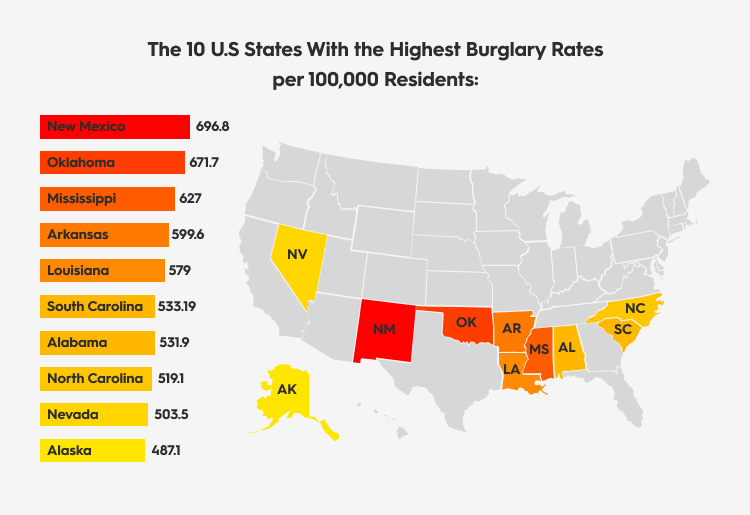
Source: FBI 2019 Uniform Crime Report
The FBI defines burglary as “the unlawful entry of a structure to commit a felony or theft,” which includes both forced entry as well as non-forced entry cases. Structures that meet the definition included apartments, house trailers, barns, offices, permanent residential houseboats, railroad cars, stables, and vessels such as ships.
In 2019, the US saw around 1,117,696 cases of home burglary nationwide, according to the FBI’s 2019 Uniform Crime Report.
The good news is that the total number of home burglaries has decreased 9.5% from the previous year.
Nonetheless, home burglaries still rank as the 3rd most commonly committed crime in the country.
The thought of a home invasion may seem hard to grasp, especially if you think you live in a safe area. In reality, burglaries can happen to anybody and when they do the experience can be traumatizing.
The 2019 FBI report mentioned a few interesting stats:
To prevent the worst from happening, you can use a home security system to monitor your house, or simply employ your neighbors to help keep watch when you're out of town.
No matter if you're a homeowner or a renter, there are many options out there to keep your home safe, and this includes keeping a tab on changing crime patterns across states.
The Best Home Security Systems for Protecting What Matters Most
Top 10 Ways to Protect Your Home When Traveling for the Holidays
Scott currently writes full-time for top10.com and has worked as a writer, editor, and researcher for top tech companies, including Groupon. Over the last decade he has covered stories in emerging tech, consumer trends, medical and wellness technology, media, science, and culture.