Is Jimdo Worth Signing Up For?
Jimdo Pros & Cons
Pros
Cons
Jimdo at a Glance
Easy-to-use
Website Packages
Reliability
Customer Service
Integrations
How Jimdo Works
Jimdo is an AI-powered website builder founded in Hamburg in 2007 and still 100% founder-owned. The company employs around 230 people worldwide and has supported the creation and growth of more than 36 million websites. It started as a simple website builder and has since grown into a platform that helps solopreneurs and small businesses not just build a site, but run the business around it.
Jimdo's focus is simplicity, integrated tools, and European (GDPR) compliance, with a particularly strong following in the DACH market. It's ideal for service-based professionals — coaches, photographers, consultants, therapists, yoga instructors, and local businesses — who want a professional site fast and without technical fuss. Designers and agencies who need pixel-level control will still be better served elsewhere. Along the way, Jimdo offers a blog, an extensive help center, and an active user community.
Using Jimdo
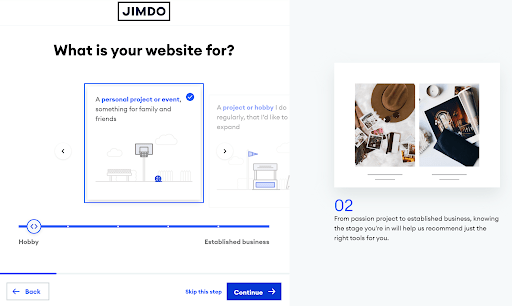
Getting started with Jimdo is refreshingly quick. You sign up for free — no credit card required — and instead of picking a template, you tell Jimdo's AI what you do. It asks a few questions about your business, then generates a complete site: structure, copy, images, and calls to action tailored to your industry. Most users are online in under five minutes. From there, you refine everything in a clean, guided editor, with no steep learning curve or clutter to fight through.
Jimdo Features and Tools
AI Website Builder
Jimdo's AI creates a business-ready website from a short conversation about what you do. The content it produces is SEO-optimized and structured so it can be surfaced by search engines and AI assistants like ChatGPT, not just Google — a genuine edge over most builders.
Page Editor & Blocks
Rather than dragging individual elements, you build with pre-made blocks — image-and-text, banners, galleries — that you can add, reorder, show, or hide. It's fast and beginner-friendly, though control over each block's internal layout is limited.
SEO Tools
Paid plans include SEO tools with editable meta titles and descriptions, one-click re-indexing after major changes, and personalized guidance. Jimdo now also structures content to be picked up by AI assistants. Analytics come via Google Analytics rather than a deep built-in suite.
Ecommerce
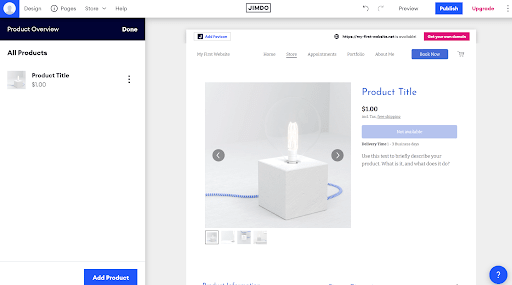
Jimdo remains one of the cheaper ways to launch an online store, with product pages, one-click checkout, discount codes, and payment via PayPal, Square, and others. It's built for simple storefronts rather than large, complex catalogs.
How To Create a Website with Jimdo
Creating a site with Jimdo is different from most builders because you never start from a blank template. Instead, you answer a few questions about your business and the pages you want, and Jimdo's AI generates a personalized site for you to customize with its page editor.
You then work in pre-built blocks that you can add, reorder, show, or hide. There are dozens of them, so building out content is fast, though your control over each block's internal layout is limited. Styling is similarly streamlined: you can adjust your color palette, fonts, and button shape, but not things like block padding or footer layout. Every Jimdo site is mobile-responsive out of the box.
The result is a design experience that strongly favors speed over fine-grained control. If your priority is getting a professional site live quickly, Jimdo delivers. If you want to craft a highly bespoke look, you'll feel the guardrails. The one thing we'd most like to see improved is deeper layout customization for users who outgrow the block system.
Adding Multimedia
Jimdo lets you import images and videos from your computer, Facebook, and Instagram, and it saves everything to a media library where you can add alt text and reuse assets across your site. If you import images during setup, the AI designer works them into the site it builds for you. You can also embed audio via Spotify or a link, though there's no native support for uploading documents or PDFs.
Marketing Functionality
Jimdo covers the basics with business listings and social integration to promote across Facebook, Instagram, WhatsApp, and Google, plus lead-capture forms. Dedicated blogging and heavy email-marketing suites still aren't its focus, so content marketers may want to pair it with other tools.
SEO Functionality & Add-Ons
On paid plans, Jimdo helps your pages rank on Google with editable metadata, re-indexing, and personalized SEO advice — and now structures content for AI assistants too. For deeper measurement, you can connect Google Analytics.
Beyond the Website: Jimdo's Business Tools
What increasingly sets Jimdo apart from other website builders is what happens after the site is live. Alongside the builder, Jimdo bundles a booking tool for unlimited one-on-one, group, and recurring appointments, AI-drafted smart forms for enquiries, automatic invoices generated from bookings and orders, and payment links customers can pay in one click. Everything connects to a single customer database, so a solopreneur can get found, get booked, and get paid without stitching together separate apps. If you only need a website, you can ignore these entirely — but for a small service business, having them built in is a real convenience.
How Much Does Jimdo Cost?
Jimdo offers a genuinely free forever plan, with paid tiers that unlock a custom domain, more storage, ecommerce, and the business toolkit. Paid plans are billed annually and come with a money-back guarantee. Because Jimdo updates its plans and pricing periodically, check the current rates on Jimdo's site before signing up — and note whether the renewal rate differs from any introductory offer.
Plan detail | What to expect |
|---|---|
Free plan | Yes — build and publish at no cost |
Paid plans | Billed annually; unlock domain, storage & more |
Free domain | Included for the first year on paid plans |
Ecommerce | Available on store plans |
Extra business tools | Bookings, invoicing & payments in the toolkit |
Money-back guarantee | Yes |
Jimdo Help and Support
Jimdo offers 24/7 customer support by email, with faster response times on higher-tier plans. There's no phone line or live chat, which is the main gap for anyone who wants to talk a problem through in real time. Backing up email support is an extensive help center full of how-to articles, plus a blog and an active user community. In-product tips and the AI assistant also help you resolve many questions without contacting support at all.
How To Cancel a Jimdo Subscription
You can manage or cancel your plan from your account settings under the billing or subscription section, where you can downgrade to the free plan or end a paid subscription before it renews. If you're within the money-back guarantee window, you may be eligible for a refund. Cancellation policies can change, so confirm the current terms in Jimdo's help center before you cancel.
Is There a Jimdo App?
Yes — Jimdo offers mobile apps that let you manage your site on the go, from editing pages to keeping on top of orders and bookings. If you prefer to work in a browser, the platform is fully usable on mobile as well, so you're not tied to a desktop to keep things running.
How Jimdo Compares to Other Website Builders
Jimdo competes with the big website builders on speed and value. Where it pulls ahead is the business tooling it builds in; where it falls behind is design flexibility and content features like blogging.
Jimdo | Wix | Squarespace | |
|---|---|---|---|
Pricing | From $0 | From $17/mo | From $16/mo |
Hosting included? | Yes | Yes | Yes |
AI website builder | Yes | Yes | Limited |
Number of templates | AI-designed layouts | 900+ | 100+ |
Blogging functionality | No | Yes | Yes |
Ecommerce functionality | Yes | Yes | Yes |
Built-in bookings & payments | Yes | Via apps | Add-ons |
Responsive design | Yes | Yes | Yes |
Competitor pricing shown for context and changes frequently — check each provider's site for current rates.
Jimdo vs Wix
Wix is far more flexible and has a huge library of design elements and templates, making it the better pick if you want complete control over how your site looks. But it takes longer to master. Jimdo gets you live faster and bundles business tools Wix only offers through separate apps.
Jimdo vs WordPress.com
WordPress.com is built first for content and blogging and scales enormously with plugins, but it carries a steeper learning curve and more setup. Jimdo is the simpler, more guided choice for a small business that wants a professional site quickly, without managing plugins.
Jimdo vs Squarespace
Squarespace wins on design polish and depth of blogging and ecommerce tools, at a higher price point. Jimdo trades some of that design range for faster setup, a free entry point, and built-in bookings and payments — a better fit for solopreneurs who value speed over bespoke design.
Bottom Line
Jimdo's standout quality is speed: its AI builds a professional, SEO-ready website from a few simple questions, and unlike most builders it bundles in business tools like bookings, invoicing, and payments. For a solopreneur who wants to be online and taking customers fast, that combination is hard to match at the price.
The downside is that you give up creative freedom — you can't drag and drop individual elements, and style options are limited — and there's no blogging or phone support. So Jimdo is best for solopreneurs and small service businesses who prioritize speed, value, and simplicity over granular design control. If you want a highly customized, design-led site, a more flexible builder will suit you better. And you can start for free.
 FAQs
FAQsHow do I know I can trust this review?
Michael Graw is a freelance writer specializing in finance, business, and tech who writes for Top10.com. His work has appeared in numerous well-known online and print publications, including Techradar, BestMoney, Business2Community, Day Trade Reviews, Pacific Standard, Fortune, Business Insider, and more.