Last Updated: Jun 2026
1
Award Winning Service

monday.com AI Work Platform
 Start Free
Build and deploy AI agents for real work on one secure AI work platform
- No-code AI agent builder for business teams
- Connects agents to boards, tools, and knowledge
- Scoped permissions, logs, and human oversight
- Unlimited time on Free plan, no commitment
9.8
Exceptional
Did you know?
AI tools have boosted workplace productivity by an average of 66%, freeing teams to focus on big-picture strategy. (Deloitte, 2026)


Our Most Popular Pick
Frequently Asked Questions
What is an AI tool for business?
An AI tool for business is software that uses artificial intelligence to help teams complete work more efficiently. This can include drafting content, summarizing information, automating workflows, supporting customer communication, or improving search visibility.
What is the difference between an AI assistant and an AI agent?
An AI assistant usually helps with prompts, summaries, writing, and support tasks. An AI agent is typically designed to take action within defined workflows, tools, or systems, often with permissions and logic attached.
Are AI tools suitable for small businesses?
Yes. Many AI business tools are designed for teams of different sizes, from smaller businesses that want lightweight support to larger organizations that need enterprise AI controls, integrations, and governance.
Can AI automation replace employees?
No. AI automation is usually most effective when it reduces repetitive work and supports people, not when it replaces business judgment. Human review is still important for accuracy, context, and decision-making.
What should businesses look for before adopting enterprise AI?
Businesses should look at security, permissions, visibility, integrations, data handling, scalability, and whether the product solves a clear use case. The best enterprise AI solutions support control and adoption, not just new features.
What is AI-enhanced business software, and why does it matter?
AI-powered business platforms are no longer limited to a single workflow or team. Today’s leading AI tools combine automation, content support, knowledge access, search visibility, and intelligent assistance in one place, helping businesses work faster and make better decisions. Whether you need an AI assistant for daily tasks, an AI agent for workflow execution, or enterprise AI capabilities for scale and governance, modern software is built to support a wide range of business needs.
Leading platforms now use artificial intelligence for business to help teams:
Centralize information, tasks, and team knowledge
Automate repetitive work with AI automation
Support research, writing, summaries, and follow-ups with an AI helper
Improve speed, consistency, and visibility across business workflows
In today’s fast-moving digital environment, these solutions are becoming core AI business tools for teams that want to do more with less.
What are our partners’ key AI tools?
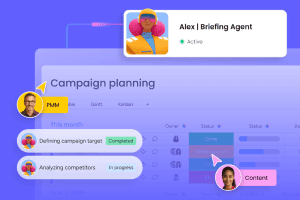
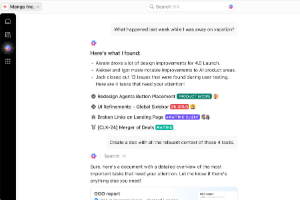
monday.com agents lets teams build and deploy AI agents that execute real work across a secure AI work platform. It supports no-code setup, connections to knowledge and tools, activity logs, permissions, and human oversight, making it relevant for businesses exploring AI agent and enterprise AI use cases.
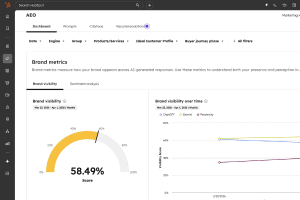
HubSpot AEO tracks how brands appear in AI-generated answers and helps businesses improve visibility in AI search results. It is relevant for companies focused on AI for business growth, discoverability, and presence across answer engines.
Both brands show how broad the current market for AI tools has become: from workflow execution and assistance to AI search visibility.
Why now? The 2026 landscape for AI tools
The momentum behind AI tools is being driven by:
The need to reduce repetitive work and improve business efficiency
The rise of AI assistant and AI agent experiences built into everyday software
Growing demand for AI automation that supports teams without adding operational complexity
Increased focus on enterprise AI governance, visibility, and secure deployment
A broader shift toward artificial intelligence for business as a practical operating layer, not just an experiment
How to choose the right AI business tools?
When evaluating AI business tools, focus on these core factors:
Define your top use cases, such as writing, research, automation, support, or visibility
Check whether the platform supports teams, workflows, and tools you already use
Review security, permissions, and admin controls for business use
Look for easy onboarding and a user-friendly experience
Confirm pricing, scalability, and plan flexibility
Prioritize privacy, documentation, and vendor support
Read customer examples, reviews, or product use cases for real-world fit
What are the limitations or challenges of AI tools?
While AI tools can improve speed and efficiency, they are not magic solutions. Strong results still depend on clear goals, quality inputs, sensible workflows, and human oversight. Even the most capable AI assistant or AI helper may produce weak outputs if the source material is limited, outdated, or unclear.
Here are a few common limitations businesses may face:
AI outputs depend heavily on the quality of the data, prompts, and context provided
An AI agent can help execute work, but it still needs boundaries, permissions, and review
Some AI automation tools require setup time, process design, and team adoption to deliver value
Different tools vary widely in reliability, explainability, and business readiness
Using enterprise AI at scale requires attention to privacy, access controls, and governance
Even when a virtual AI assistant saves time, human judgment remains essential. Businesses should treat AI as support for decision-making and execution, not as a substitute for accountability.
Comparing the top AI tools
Below is a broad snapshot of leading AI tools, focused on what each one is most commonly recommended for today.
Software | Most recommended for |
monday.com Agents | Building and deploying AI agents inside team workflows |
ClickUp Brain | AI-assisted productivity, summaries, and workspace support |
HubSpot AEO | Improving brand visibility in AI search results |
Notion AI | Knowledge work, drafting, and workspace assistance |
Zapier | Cross-app AI automation and workflow orchestration |
Grammarly | Writing support and AI-assisted communication |
Jasper | AI-assisted marketing and content creation |
ChatGPT | General-purpose AI assistant use across research, writing, and ideation |
monday.com Agents vs HubSpot AEO
monday.com Agents focuses on workflow execution and operational support through agents and automation. HubSpot AEO improves how businesses appear in AI-generated answers and strengthens visibility in AI search. One supports internal AI automation and execution, while the other supports discoverability and growth.
Top10.com Total Score
Our product scores consist of a combination of the following 3 components:
Popularity
Top10.com measures user engagement based on the number of clicks each listed brand received in the past 7 days. The number of clicks to each brand will be measured against other brands listed in the same query. Therefore, the higher the share of clicks a brand receives in any specific query, the higher the Click Trend Score. Top10.com accepts advertising compensation from companies, which impacts their (and/or their products’) position, and in some cases, may also affect their Click Trend Score.
Brand Reputation
Semrush is a trusted and comprehensive tool that offers insights about online visibility and performance. The Top10.com Total Score will consist of the brand's reputation from Semrush. The brand reputation is based on Semrush's analysis of clickstream data, which includes user behavior, search patterns, and engagement, to accurately measure each brand's prominence, credibility, and trustworthiness. If a brand does not have a Semrush score, the Top10.com Total Score will be based solely on the Click Trend Score and Products & Features Score (read below).
Features & Benefits
Top10.com editorial team researches and reviews financial products based on factors such as: range of products and services offered, ease-of-use, online accessibility, customer service, special awards, and more. Each brand is then given a score based on the offerings in each parameter. The specific parameters which we use to evaluate the score of each product can be found on its review page.
Editorial Reviews



Smartsheet Alternatives: 5 Similar Options for Project and Task Management
Dec 16, 2025
Wrike Alternatives: 5 Best Project Management Software to Try in 2026
Dec 15, 2025
Asana Alternatives: 5 Best Project Management Software to Try in 2026
Dec 15, 2025


